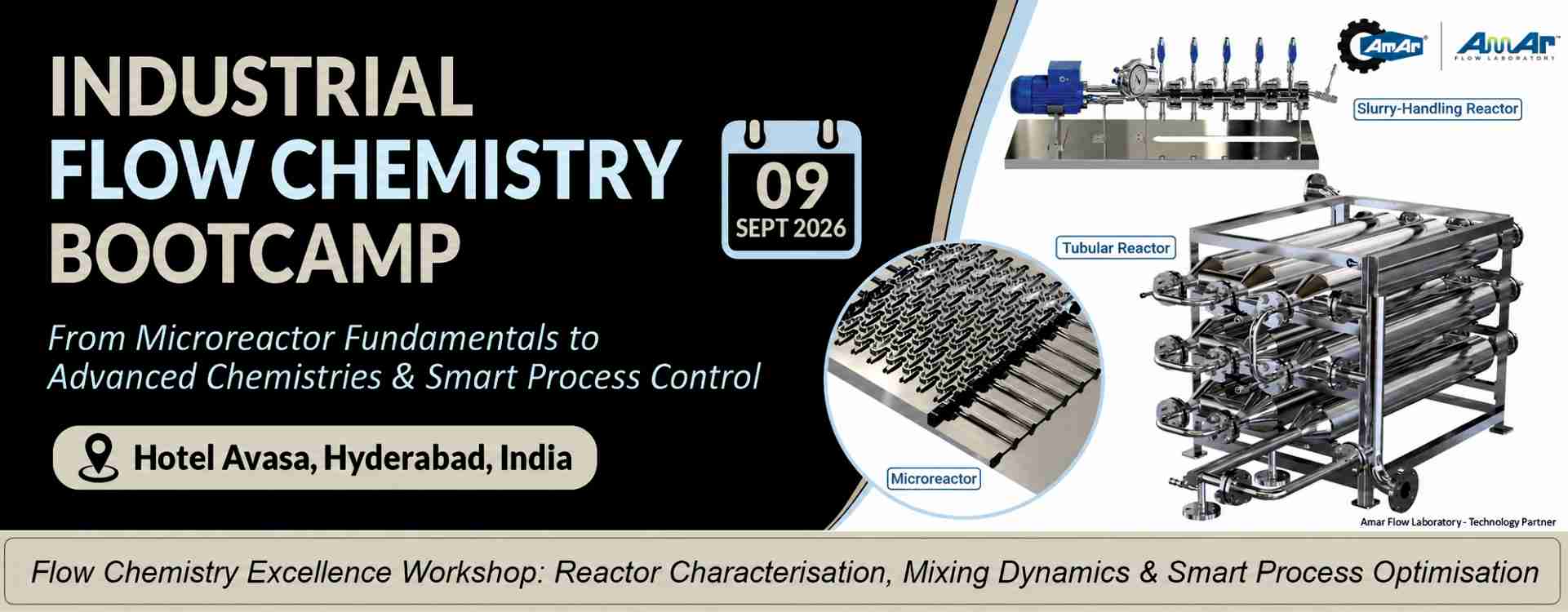
Industrial Flow Chemistry Bootcamp
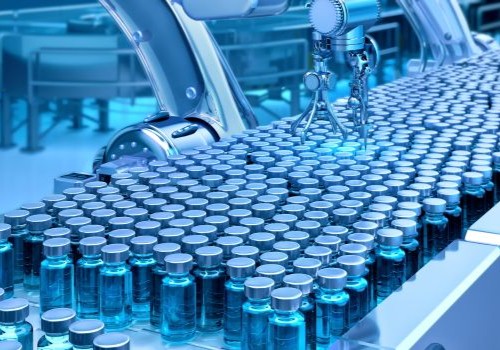
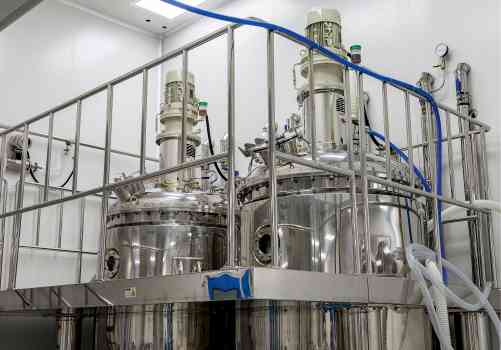
The Industrial Flow Chemistry Bootcamp: From Microreactor Fundamentals to Intelligent Process Control is an intensive, application‑driven training program designed specifically for mid‑level chemists and chemical engineers working in the API and chemical manufacturing sectors. This bootcamp equips participants with the scientific depth and practical skills needed to confidently adopt continuous processing in real industrial environments.
The program builds a strong foundation in microreactor technology, mixing science, residence time distribution (RTD), slurry behaviour, and the handling of fast or highly exothermic reactions. Participants will also explore advanced chemistries-including catalysis, photochemistry, electrochemistry, mechanochemistry, and gas‑phase transformations-and understand how these benefit from continuous flow operation.
Led by Prof. Marcus Baumann, the morning theory session is followed by live demonstrations led by experts from Amar Flow Laboratory on mixing analysis, slurry handling, reactor characterisation, and AI‑enabled optimisation. The bootcamp emphasises real‑world decision‑making, scale‑up considerations, and data‑driven process improvement. Participants are required to bring a laptop for hands‑on calculations and exercises.
Please note that photography/videography of the scientific contents presented at the bootcamp is strictly prohibited. We will share the presentations with the delegates only if provided and allowed by the respective speakers.
Conference Date
09-09-2026
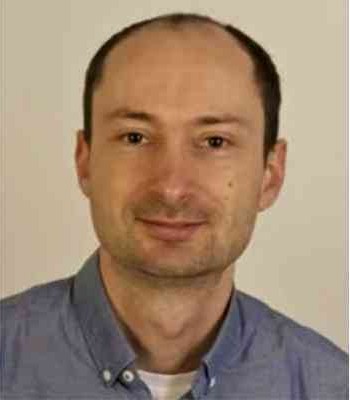
Marcus Baumann's Biography
Dr Marcus Baumann graduated from Philipps-University Marburg (Germany) in 2007 before moving to Cambridge/UK to study for a PhD with Prof. Steven V. Ley FRS. On completion of his PhD in 2010 he was awarded a Feodor-Lynen postdoctoral fellowship by the Humboldt foundation allowing him to join the research group of Prof. Larry E. Overman at the University of California in Irvine. After two years in Irvine, he returned to the UK to work with Prof. Ian R. Baxendale at the University of Durham applying flow methodology to the scaled synthesis of biologically relevant chemical entities.
In 2017 he became an Assistant Professor for Continuous Flow Chemistry at University College Dublin, where his group’s efforts centre around the development of new continuous flow methods applied to the effective generation of various target molecules. In 2021 he was a Visiting Professor at the University of Toronto. Current areas of interest include process development, reaction scale-up, photochemistry, telescoped multi-step sequences and flow biocatalysis.
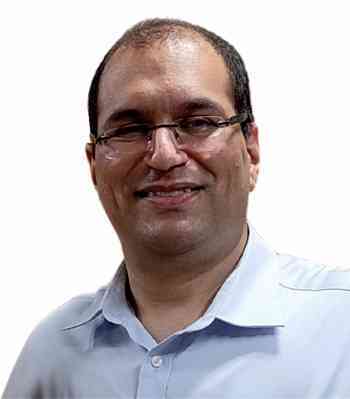
Vishwanath H. Dalvi's Biography
Dr. Vishwanath H. Dalvi is the R. A. Mashelkar Assistant Professor at the Institute of Chemical Technology, Mumbai. His vision is for India to be a resilient, secure, knowledge based economy. His research focuses on sustainable development and economic empowerment. To that end, he works on developing technologies that are imperatively decentralized e.g. micro CSP power generation, waterless toilets, novel biogas generators and open source process engineering tools. He is known to be an excellent teacher having won awards for teaching both from the Institute of Chemical Technology and from the All India Council of Technical Education.
Conference Agenda
- Foundations of Flow Chemistry & Microreactor Technology
- Mixing in Microreactors: Principles, Characterisation & Measurement
- Residence Time, RTD & Reactor Sizing
- Practical Operation of Microreactors
- Applications & Case Studies in Flow Synthesis
- About the Equipment and Demonstration
Agenda Topics for Industrial Flow Chemistry Bootcamp
-
Foundations of Flow Chemistry & Microreactor Technology
- Microreactor architectures and design principles
- Heat & mass transfer intensification
- Safety, scalability, and regulatory relevance
- Catalysis in flow (homogeneous, heterogeneous, biocatalysis)
- Photochemistry in flow (LED reactors, photon flux control)
- Electrochemistry in flow (electrode design, ion transport)
- Mechanochemistry in continuous systems (emerging field)
- Gas phase and gas–liquid reactions in microreactors
- Why flow chemistry matters for API and fine chemicals
-
Mixing in Microreactors: Principles, Characterisation & Measurement
- Impact of mixing on selectivity, impurity formation, and yield
- Laminar flow, diffusion controlled mixing
- Micromixing vs macromixing
- Using the Fourth Bourne Reaction as a quantitative probe
- Determining micromixing time
- Correlating mixing efficiency with reactor geometry and flow rate - Villermaux-Duschmann ‘iodide-iodate’ reaction
- Why fast/exothermic reactions demand excellent mixing
- Avoiding hotspots and runaway conditions
- Inline temperature monitoring and heat removal strategies
-
Residence Time, RTD & Reactor Sizing
- Methods to measure RTD in lab reactors
- How to translate RTD data from lab → pilot → plant scale
- Why RTD matters for: impurity control, scale up, telescoped reactions, crystallisation and particle formation
- Calculating residence time
- Plug flow vs dispersion
- Reactor volume determination for desired throughput
- What is Mean Residence Time Distribution (MRTD)
-
Practical Operation of Microreactors
- Pump selection and flow control
- Temperature and pressure management
- Inline quenching, sampling, and analytics
- Troubleshooting (clogging, pulsation, fouling)
- Particle size distribution and settling
- Slurry transport in microchannels
- Avoiding clogging: velocity, channel design, ultrasound, oscillatory flow
- Inline filtration and continuous solid handling
- Case studies: crystallisation, heterogeneous catalysis, metal reductions
-
Applications & Case Studies in Flow Synthesis
- Nitrations, oxidations, reductions
- Photochemical transformations
- Electrochemical oxidations/reductions
- Gas–liquid reactions (carbonylations, hydrogenations)
- Telescoped multi step sequences
- API intermediate examples
- How flow improves safety, quality, and sustainability
-
About the Equipment and Demonstration
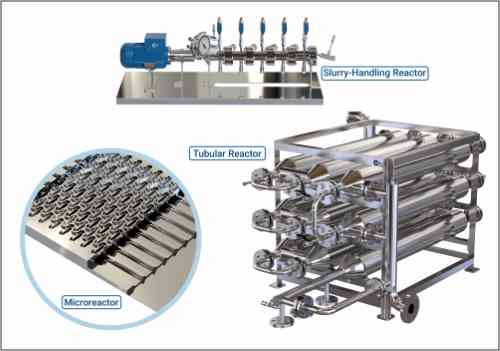
- Demonstration 1+Hands-on: Residence Time Distribution (RTD) Study on MicroFLO™ and SlurryFLO™ platforms
- Demonstration 2: Mixing Efficiency & Micromixing Time using MicroFLO™ microreactor
- Demonstration 3: Handling Slurries in Continuous Flow using SlurryFLO™ reactor
- Demonstration 4: CogniFLO™ Closed-Loop Auto-Optimisation
Who should attend
- R&D and Process Development Chemists (API & Chemical Industry)
- Process Engineers & Scale‑Up Specialists
- Manufacturing, Operations & Technology Transfer Teams
- Catalysis, Photochemistry & Electrochemistry Specialists
- Process Safety & Quality Teams
- Innovation, Technology Scouting & Strategy Leaders
Who should attend
-
R&D and Process Development Chemists (API & Chemical Industry)
Professionals responsible for developing, optimising, and troubleshooting synthetic routes who need deeper understanding of:
- Microreactor fundamentals
- Mixing efficiency (including Fourth Bourne)
- RTD and scale‑up behaviour
- Handling fast/exothermic reactions
- Applying flow to catalytic, photochemical, electrochemical and gas‑phase transformations -
Process Engineers & Scale‑Up Specialists
Engineers involved in translating lab chemistry into pilot and commercial scale continuous processes:
- Reactor characterisation and RTD interpretation
- Slurry behaviour and solid handling in flow
- Heat/mass transfer in microreactors
- Pressure, temperature and flow control
- Intelligent/AI‑enabled optimisation -
Manufacturing, Operations & Technology Transfer Teams
Plant‑facing professionals who want to adopt or expand continuous processing capabilities:
- Implementing flow reactors in existing facilities
- Managing exothermic and hazardous chemistries safely
- Ensuring reproducibility and robustness
- Troubleshooting flow equipment and process deviations -
Catalysis, Photochemistry & Electrochemistry Specialists
Experts working on enabling technologies who want to understand:
- How activation technologies behave in continuous systems
- Photon/electron flux control
- Reactor design considerations for advanced chemistries
- Integration of catalytic and gas‑phase reactions in flow -
Process Safety & Quality Teams
Professionals ensuring safe and compliant operations:
- Thermal management of fast/exothermic reactions
- RTD implications for impurity control
- Safer handling of hazardous transformations
- Continuous processing advantages for regulatory alignment -
Innovation, Technology Scouting & Strategy Leaders

Decision‑makers evaluating continuous flow as a strategic capability:
- Assessing ROI and operational benefits
- Understanding where flow adds value in API and chemical manufacturing
- Identifying opportunities for digitalisation and intelligent control
Conference Officials
WhatsApp: 9041725050
Speakers & Panelists
Marcus Baumann's Biography
Dr Marcus Baumann graduated from Philipps-University Marburg (Germany) in 2007 before moving to Cambridge/UK to study for a PhD with Prof. Steven V. Ley FRS. On completion of his PhD in 2010 he was awarded a Feodor-Lynen postdoctoral fellowship by the Humboldt foundation allowing him to join the research group of Prof. Larry E. Overman at the University of California in Irvine. After two years in Irvine, he returned to the UK to work with Prof. Ian R. Baxendale at the University of Durham applying flow methodology to the scaled synthesis of biologically relevant chemical entities.
In 2017 he became an Assistant Professor for Continuous Flow Chemistry at University College Dublin, where his group’s efforts centre around the development of new continuous flow methods applied to the effective generation of various target molecules. In 2021 he was a Visiting Professor at the University of Toronto. Current areas of interest include process development, reaction scale-up, photochemistry, telescoped multi-step sequences and flow biocatalysis.
Assistant Professor,
University College Dublin,
Ireland
Vishwanath H. Dalvi's Biography
Dr. Vishwanath H. Dalvi is the R. A. Mashelkar Assistant Professor at the Institute of Chemical Technology, Mumbai. His vision is for India to be a resilient, secure, knowledge based economy. His research focuses on sustainable development and economic empowerment. To that end, he works on developing technologies that are imperatively decentralized e.g. micro CSP power generation, waterless toilets, novel biogas generators and open source process engineering tools. He is known to be an excellent teacher having won awards for teaching both from the Institute of Chemical Technology and from the All India Council of Technical Education.
Advisor - Flow Technology,
Amar Flow Laboratory,
India
Venue
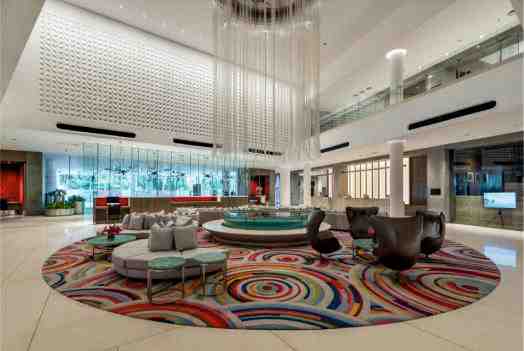
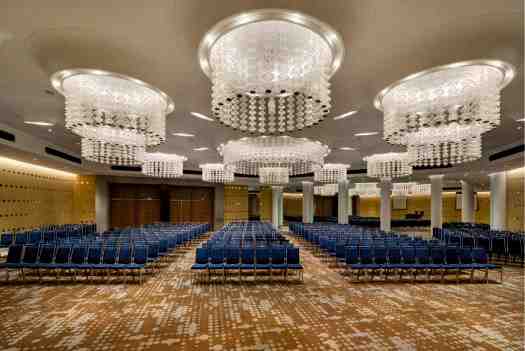
Avasa Hotel, Madhapur, Hyderabad
Address: Survey No. 64, Plot No. 15, 24, 25 & 26, Hitech City Rd, HUDA Techno Enclave, HITEC City, Hyderabad, 500081, Telangana
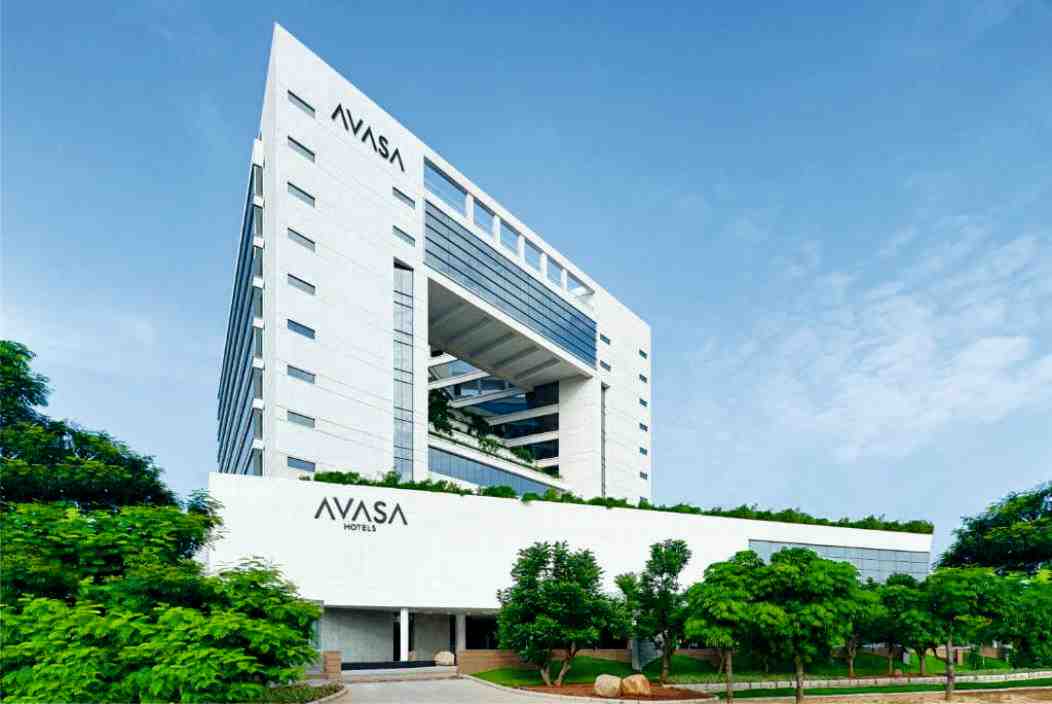
AVASA the new 5 Star hotel with 217 rooms has been designed by renowned International Architect Ed Poole of Singapore. Presently open with its all day dining restaurant Pi meeting and banqueting space and guest rooms Soon to open will be the Oriental restaurant Ohm the Spa Business Club and a Sky lounge and bar on the 10th and 11th level.
Nestled in the heart of the it and pharmacy hub of Hyderabad, Avasa embodies the bold and modern face of the bustling metropolis, while offering a quick getaway to the streets of heritage Hyderabad. A confluence of contemporary styles and time-tested service, Avasa hotel offers tasteful luxury for the discerning globetrotter.
We could write reams about our contemporary design. Speak endlessly about comfort. Elaborate on the functionality of our rooms at length. But then, why let details come in the way of a good story.
Conference Sponsors
Technology Partner
Knowledge Partner
Sciknowen
IT Partner
Amar Flow Laboratory
Cozy Meets
CozyMeets is an online store for all your event, meeting and conference needs, corporate/business gifting as well as event arrangements. We present ourselves as a one-stop solution to all your conference needs, requirements like kits, stationery, gifts, website development, designing & printing, bulk posting, emails, SMS and other indoor and outdoor arrangements. Just drop us a message and we will be right there beside you.
With an experience of over 20 years, we not only meeting supplies and conference requirements but also guide our customers on most viable and best products most suited for their meeting or event. We bring to your doorsteps branded, generic and customized products. We connect our customers with the manufacturers to design and customize a product of the customer's choice be it conference bag or stationary item or gift or website etc.
So when you plan to organize a small meeting or a conference or an event, just drop us an email or send us a message and we will be there for you. You can also ask us for conference facilities required, conference hall checklist, conference requirement checklist etc for managing your meeting perfectly and making your organizing experience cozy.
Sciknowen
Sciknowen
Digilinkers
Digilinkers is a results-focused digital marketing company based in Delhi, helping businesses succeed in the digital space. From startups to large enterprises, our goal is to deliver campaigns that bring real, scalable growth. With a perfect mix of creativity, tech, and marketing strategies, we have earned a reputation as the No. 1 digital marketing service provider Delhi relies on.
Industrial Flow Chemistry Bootcamp Draft Programme
Download Programme PDFWednesday, 9th September 2026
| 08:00 |
Registration
|
| 09:00 |
Foundations of Flow Chemistry & Microreactor Technology
Core Concepts • Why flow chemistry matters for API and fine chemicals |
| 09:45 |
Mixing in Microreactors: Principles, Characterisation & Measurement
Core Concepts • Laminar flow, diffusion‑controlled mixing |
| 10:45 |
Tea Break
|
| 11:00 |
Residence Time, RTD & Reactor Sizing
Core Concepts • Calculating residence time |
| 11:45 |
Practical Operation of Microreactors
Core Concepts • Pump selection and flow control |
| 12:30 |
Applications & Case Studies in Flow Synthesis
Core Concepts • Nitrations, oxidations, reductions |
| 13:15 |
Q/A Session
|
| 13:30 |
Lunch
|
| 14:30 |
About the Equipment and Demonstration
Demonstration 1+Hands-on: Residence Time Distribution (RTD) Study on MicroFLO™ and SlurryFLO™ platforms |
| 17:30 |
Closing Remarks
|
Registration
Register Now| Category | Currency | Base Fee | GST / Tax % | Total (incl.) |
|---|---|---|---|---|
|
Indian Delegate
|
INR | ₹20,000.00 | 18% | ₹23,600.00 |
|
Overseas Delegate from Europe
|
EUR | €250.00 | 18% | €295.00 |
|
Overseas Delegate from US
|
USD | $250.00 | 18% | $295.00 |